


 Back to other articles








 Last updated: September 28, 2026

 Interviews
 Behavioral
 Deeply researched
Amazon interviews are famous for being extremely focused on behavioral questions. No matter how brilliant you are at your role, whether you get an offer or not still depends on your behavioral interview performance.
In an Amazon behavioral interview, you’ll need to give detailed, structured answers showing your alignment with the company’s Leadership Principles. You’ll also need to respond confidently to tricky follow-up questions as the interviewer probes for specific details.
To help you prepare with confidence, we’ve created this guide. It contains everything you need to know to crack Amazon’s behavioral interview: the core values driving the interview, example questions and how to answer them, insight and tips from ex-Amazon Bar Raisers and interviewers, and a prep plan to make sure you land your dream job at the company.
Here’s an overview of what we’ll cover:
- What is the Amazon behavioral interview?
- Amazon behavioral interview question bank
- How to answer Amazon behavioral interview questions
- Amazon behavioral interview tips
- How to prepare
Click here to practice 1-on-1 with ex-Amazon interviewers
1. What is the Amazon behavioral interview?↑
Amazon uses behavioral interviews to assess job candidates based on their past experiences. They can appear at any point in the Amazon interview process. They may even be used as icebreakers or transition questions during technical screens. The frequency and type of behavioral questions will vary per role, but be prepared for many.
Behavioral questions typically start with “Tell me about a time you…” and focus on soft skills articulated in the 16 Leadership Principles. Areas of focus usually include leadership, ambiguity, problem-solving, bias for action, etc. We'll go into more detail on these below.
1.1 What is Amazon looking for in a candidate?
Amazon interviewers and Bar Raisers look out for the following traits when screening Amazon candidates:
- A customer-first and data-driven mindset that guides decisions
- Clear, thoughtful, and structured communication
- Clear thinking and adjusting well in ambiguous situations
- Taking responsibility for outcomes, not just tasks
- Willingness to challenge decisions and status quo (respectfully) with data and logic, push for what’s right
- Ability to learn quickly and evidence of coachable leadership — learning, teaching, and raising others
“It’s not just about technical skills or functional expertise — it’s about leadership, judgment, and whether this person will thrive in Amazon’s unique culture,” says Anurag (Amazon software engineering leader and Bar Raiser).
To find candidates with these traits, interviewers and Bar Raisers use Amazon’s Leadership Principles as their guide for assessment.
If you’re going into an Amazon interview, familiarizing yourself with the company’s Leadership Principles should be a top priority. Let’s get into them in detail below.
1.2 What are Amazon’s Leadership Principles?
Amazon's Leadership Principles encapsulate the core values and behaviors that guide decision-making and actions across the company. Each principle emphasizes different aspects of Amazon's culture, from prioritizing customer needs to fostering innovation, maintaining high standards, and acting with urgency and integrity.
The idea is that these principles serve as a common language and framework for Amazonians to align their work and behaviors with the company's long-term vision and goals. As you might have guessed, candidates need to be very familiar with them!
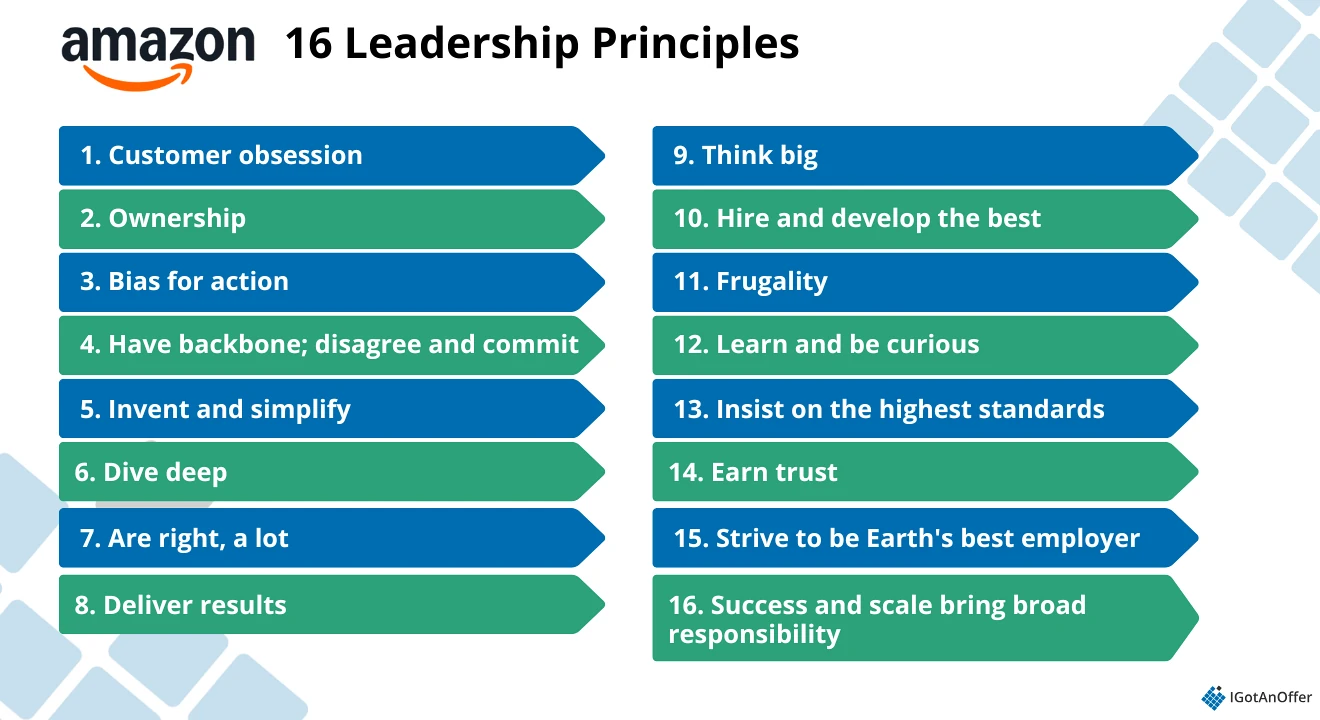
In section 2, we’ll dig deeper into each principle and the interview questions that will test you on them.
1.3 What could lead to a rejection at an Amazon behavioral interview?
Even if you performed brilliantly at your technical interviews, one false move at your Amazon behavioral interview could still get you rejected. Here are four possible reasons why a candidate might ‘fail’ an Amazon behavioral interview, according to ex-Amazon Bar Raiser Aimee.
1.3.1 Not enough “I” impact
Always using “we” when talking about past projects could signal that you cannot confidently talk about your own impact.
If you’re applying for a people-manager role, you should, of course, talk about “we” as you’d want to show that you’re a team leader and collaborator. But you’d still want to strike a good balance between your own contribution and your team's collective effort.
“It is very important for a candidate to really isolate and identify: this is what I did,” Aimee says.
1.3.2 Crumbling when probed
Many candidates come prepared to an Amazon behavioral interview with their stories, which is great. However, most seem to over-prepare and over-rely on their scripts and do not prepare at all for the probing that can happen.
One of Amazon’s LPs is ‘dive deep’ and interviewers stay true to this LP by asking follow-up questions. They will do this either out of curiosity or when they feel like you haven’t answered the question 100% the first time.
Some candidates crumble under pressure because of nerves or because they did not expect the follow-up question at all. That’s why it’s important to do mock interviews, says Aimee, as it helps you practice for curveball questions and to go into multiple layers of your story.
1.3.3 Inconsistencies in themes
Interviewers usually spot inconsistencies in themes and stories during the Bar Raiser debrief as they review each interviewer’s candidate report.
Such inconsistencies are huge red flags; they could signal weak alignment with certain LPs, or they may lead your interviewers to doubt the veracity of your stories.
1.3.4 Not operating at the next level
This is now a huge component of the hiring process at Amazon, and it is still relative to the level that a candidate is being interviewed for.
What Amazon interviewers want to see in your behavioral interviews is your ability to think and operate at the next level.
So, for instance, if you’re applying for an entry-level role, you’re expected to tell stories that show you operating at that level, but with the potential to go to the next level.
“In terms of scope, interviewers are really asking: Can you operate at the next level? Can you think at the next level? How is your strategic thinking muscle? Is that something that you can exercise?” says Aimee.
Most crucially, what interviewers want to see is whether you can influence upwards or have influence without authority. Aimee says, “You may not be the decision maker in the room, but how are you going to influence the audience in that room to hear your perspective and take them into consideration?”
2. Amazon behavioral interview question bank (60+ questions)↑
To help you prepare strategically for your job interview, we have used Glassdoor data to identify the real questions asked in different Amazon interviews. The questions we’ve chosen come from our research on five Amazon tech roles: product manager, TPM, program manager, software development engineer, and data scientist.
To help you organize your prep, we’ve divided our Amazon behavioral interview question bank into different categories: Top 5 if you’re in a hurry; per LP if you want to go deeper into each principle; and per role if you want to see the most relevant questions for your target role. We’ve also added a quick section featuring Amazon Bar Raisers’ favorite questions and why.
Feel free to skip to the section most relevant to your needs:
Download the Amazon Leadership Principles question bank in PDF.
Let’s get started.
2.1 Amazon behavioral questions: Top 5↑
First, we wanted to highlight the most common behavioral questions that Amazon asks across every role we’ve studied. You’ll likely be asked at least one of these questions. You’ll see that regardless of the role, Amazon is curious about why you want to work for them specifically, how you face setbacks, and whether you’re willing to stand up for your ideas.
Here are the questions.
Example behavioral questions asked at Amazon: Top 5
- Why Amazon? (watch an example answer from an ex-Amazon interviewer)
- Tell me about a time you failed at work. What did you learn from it?
- Tell me about a challenge you faced. What was your role & the outcome?
- Tell me about a time you disagreed with a coworker/manager/decision
- Tell me about a time you had to work or make a decision quickly / under a tight deadline
2.2 Amazon behavioral questions: Per Leadership Principle↑
Now let’s dig deeper into each Amazon Leadership Principle, with some example questions and a few tips from our Amazon interview coaches on how to approach each LP question.
Each category below tests a different leadership principle, and the frequency of questions testing certain principles will vary depending on the role. For instance, interviews for managerial roles will include a higher number of questions targeting the principles “hire and develop the best” or “strive to be Earth’s best employer.”
Amazon’s Leadership Principles:
- Customer Obsession
- Ownership
- Bias for Action
- Have Backbone; Disagree and Commit
- Invent and Simplify
- Dive Deep
- Are Right, A Lot
- Deliver Results
- Think Big
- Hire and Develop the Best
- Frugality
- Learn and Be Curious
- Insist on the Highest Standards
- Earn Trust
- Strive to be Earth's Best Employer
- Success and Scale Bring Broad Responsibility
2.2.1 Amazon behavioral questions: Customer obsession↑
“Leaders start with the customer and work backwards. They work vigorously to earn and keep customer trust. Although leaders pay attention to competitors, they obsess over customers.”
‘Customer obsession’ is the top LP that every Amazon candidate needs to demonstrate.
Your interviewers want to know how well you understand the consequences that every decision has on customer experience. You also need to demonstrate empathy for your customer, how well you know them, and their underlying needs.
When answering Customer Obsession questions, Amazon interviewer Bilwasiva says you should begin by explaining the importance of this LP to Amazon, to show how well you understand and agree with the principle.
When telling your story, Bilwasiva advises: “Highlight your commitment to understanding and addressing customer pain points." Discuss specific initiatives or projects where you've gone above and beyond to deliver exceptional customer experiences, highlighting the outcomes and impact.
Example behavioral questions asked at Amazon: Customer obsession
- Tell me about a time you had to deal with a difficult customer.
- Which company has the best customer service and why?
- Describe a time when a customer asked you for one thing, but you knew that they needed something else.
- Tell me about one of your projects where you put the customer first.
- Tell me about a time you went above and beyond for a customer
- What is the most difficult customer situation you’ve had, and how did you handle it?
- Tell me about a time when you couldn’t meet a customer demand.
2.2.2 Amazon behavioral questions: Ownership↑
“Leaders are owners. They think long-term and don’t sacrifice long-term value for short-term results. They act on behalf of the entire company, beyond just their own team. They never say 'That’s not my job.'"
To demonstrate ownership, you’ll want to prove that you're the type to take initiative when you see a task that needs to be done. You'll also need to show how you can make tough decisions and accept responsibility for your mistakes.
To prepare answers for the Ownership LP, ex-Amazon interviewer Dessy advises talking about a product or feature that you owned from end-to-end in your previous role.
Additionally, show how you demonstrated this leadership principle by talking about "how you go to extreme distance to follow through on your projects and do whatever it takes to deliver" even when working cross-functionally or with other stakeholders. An example she gives is taking the initiative to escalate issues to the other team's leadership if necessary.
Example behavioral questions asked at Amazon: Ownership
- Tell me about a time you did something at work that wasn't your responsibility / in your job description
- Tell me about a time when you had to make an important decision without approval from your boss.
- How would you make Amazon.com better?
- Tell me about a time when you went above and beyond your job responsibility in order to help the company.
- Tell me about a situation where you took ownership of a critical issue.
- How do you handle difficult situations?
- Tell me about a time when you took complete ownership of a project and drove it to completion despite obstacles.
2.2.3 Amazon behavioral questions: Bias for action↑
“Bias for Action — Speed matters in business. Many decisions and actions are reversible and do not need extensive study. We value calculated risk-taking.”
Amazon likes to learn by doing, with an eye on results over user projections and research. This is part of what helps them act quickly and ship their products to customers as fast as they do.
To show your alignment with this LP, you’ll need to demonstrate your ability to take calculated risks to move things forward. Show you prioritize action and drive momentum in your work, and highlight instances where you've made decisions quickly and firmly.
"Provide examples of how you've taken calculated risks to achieve desired outcomes, demonstrating your ability to navigate ambiguity and drive results in a fast-paced environment," Bilwasiva says.
Also, emphasize the importance of learning from failures and iterating on ideas to continuously improve and move forward. This will also cover another leadership principle: Learn and be curious.
Example behavioral questions asked at Amazon: Bias for action
- Tell me about a time you had to make an urgent decision without data
- Tell me about a time when you launched a feature with known risks.
- Tell me about a time when you found an opportunity that no one else saw
- Can you describe a time that you had to pivot?
- Tell me about a time you made a hard decision.
- Tell me about a time you had to work with incomplete data or incomplete information.
- Tell me about a time you had to change your approach to avoid missing a deadline.
- Tell me about a time you saw an issue that your team could face and proactively took action to mitigate it.
Check out our deep dive into Amazon's Bias for Action LP for more insights and interview questions to practice with.
2.2.4 Amazon behavioral questions: Have backbone; disagree and commit↑
"Leaders are obligated to respectfully challenge decisions when they disagree, even when doing so is uncomfortable or exhausting. Leaders have conviction and are tenacious. They do not compromise for the sake of social cohesion. Once a decision is determined, they commit wholly.”
Any group of smart leaders will disagree at some point. Your interviewer will want to see that you know when to challenge ideas and escalate problems to senior leadership if necessary.
At the same time, they want to know that you can sense the right time to move forward and deliver wholeheartedly regardless of your disagreement. Show that you’re capable of striking that balance.
For this LP, prepare an example where you were able to deliver successfully on a project even though you had voiced your disagreement earlier in the process.
"Show that you understand the pros and cons of a certain decision, that even though you don't 100% agree, you can still see the merit of the decision," says Dessy.
Example behavioral questions asked at Amazon: Have backbone; disagree and commit
- Tell me about a time you had a conflict with a coworker or manager and how you approached it
- Tell me about a time your work was criticized
- Tell me about a time when people in your team didn't agree with you
- Tell me about a time when your manager challenged you to think differently.
- Have you ever stood against your boss to address a customer situation? Why and how?
- Tell me about a time you had to persuade a stakeholder to take a different approach.
- Tell me about a time when you had to stand up to your manager.
2.2.5 Amazon behavioral questions: Invent and simplify↑
"Leaders expect and require innovation and invention from their teams and always find ways to simplify. They are externally aware, look for new ideas from everywhere, and are not limited by “not invented here." Because we do new things, we accept that we may be misunderstood for long periods of time.”
Dessy explains that teams at Amazon operate relatively independently, almost like their own start-ups. This is because, despite its vast size, Amazon likes to move quickly and launch things fast.
Related to this is the fact that engineering resources are always limited, so products are launched at minimum viability. Interviewers want to know that you can respond and even thrive under these limitations.
To demonstrate this LP, Dessy says that you can prepare two kinds of stories: coming up with a minimum viable product (MVP) or phase one of a long-term project, or coming up with innovative, alternative solutions instead of building a feature that requires engineering resources.
An example she cites for the second one is using a Google form instead of building your own registration form, or changing the standard operating procedure instead of building a separate feature. This could also cover another leadership principle, Frugality.
Example behavioral questions asked at Amazon: Invent and simplify
- Tell me about a time you re-designed a process and why
- Tell me about a time you solved a big problem in your company.
- Tell me about a time when you had a plan but ran into some obstacles. What did you do about it?
- Tell us about a time where you solved a really complex problem with a simple solution.
- Can you describe your experience in managing large-scale, complex programs?
- Describe a time you solved a complex problem and you were the main problem solver.
- Tell me about a time when you were faced with a problem that had a number of possible solutions.
2.2.6 Amazon behavioral questions: Dive deep↑
"Leaders operate at all levels, stay connected to the details, audit frequently, and are skeptical when metrics and anecdote differ. No task is beneath them.”
Amazon wants candidates who have a bias for action, but also enjoy diving deep into complex problems. These LPs might strike you as two opposing ends of the spectrum, but what Amazon is really on the lookout for is if you can strike the perfect balance between the two.
Bilwasiva says your answer to this LP interview question should highlight your ability to analyze complex problems with examples of how you've conducted thorough research, gathered data, and delved into root causes to understand underlying issues.
Focus on showcasing your attention to detail, your willingness to dig deeper, asking probing questions, and challenging assumptions. Always end your stories with how your deep dive allowed you to gain valuable insights and drive informed decision-making and actions.
Example behavioral questions asked at Amazon: Dive deep
- Tell me about a project in which you had to deep dive into analysis
- Tell me about the most complex problem you have worked on.
- Tell me about a time when you used a lot of data in a short period of time.
- How do you ramp up to learn a new space/area in a project?
- Tell us about a goal that took a long time to complete.
- Tell me about a time you managed a complex project well.
2.2.7 Amazon behavioral questions: Are right, a lot↑
"Leaders are right a lot. They have strong judgment and good instincts. They seek diverse perspectives and work to disconfirm their beliefs.”
Amazon expects its employees to produce solutions as quickly as possible. This can often involve making decisions with little information.
To demonstrate this LP, you need to show that you know how to take calculated risks and that you're comfortable having your opinions challenged before moving ahead. When describing past failures, discuss what you’ve learned and how you've grown from them.
Example behavioral questions asked at Amazon: Are right, a lot
- Tell me how you deal with ambiguity
- Tell me about a time when you were faced with a problem that had a number of possible solutions.
- Tell me about a time you applied judgment to a decision when data was not available.
- Tell me of a recent event where you did something going against the natural flow or group conviction. How did it pan out?
- Describe a time when you had to make a decision against the suggestion of your larger team.
2.2.8 Amazon behavioral questions: Deliver results↑
"Leaders focus on the key inputs for their business and deliver them with the right quality and in a timely fashion. Despite setbacks, they rise to the occasion and never settle.”
Amazon values action over perfection. When answering behavioral questions about delivering results, you’ll want to indicate that you strive to avoid slipped deadlines and failed goals. If you've missed deadlines and goals in the past, explain the methods you’ve put in place to avoid them.
For this LP, Bilwasiva advises preparing specific examples of projects or initiatives where you set clear goals, developed action plans, and executed effectively to drive impactful outcomes.
"Showcase your track record of delivering measurable results and achieving key objectives in your previous roles," he says. Quantify your achievements wherever possible, using metrics and data to demonstrate the impact of your contributions.
Example behavioral questions asked at Amazon: Deliver results
- Tell me about a time you came across a scenario where the deadline given to you for a project was earlier than expected
- Tell me about the most challenging project you've ever worked on.
- Tell me about a time when you had to handle pressure.
- Tell me about a project where you had to oversee an implementation from design to delivery. How involved were you in the process?
- Tell me a situation where you did not hit your goal. How did you manage that?
- Give me an example of a time when you not only exceeded a goal, but vastly surpassed it.
- Tell me about a time you faced a challenging problem, how you approached it, and what impact your solution had.
2.2.9 Amazon behavioral questions: Think big↑
“Thinking small is a self-fulfilling prophecy. Leaders create and communicate a bold direction that inspires results. They think differently and look around corners for ways to serve customers.”
Amazon is an enormous company, so it expects its employees to build products and structures on a significant scale to make a difference in the business. To show that you have what it takes, you'll want to demonstrate that you can develop and articulate a bold vision.
To demonstrate this LP, Bilwasiva says you should cite instances showcasing your ability to envision and pursue ambitious goals that have a transformative impact on your team, organization, or industry.
"Share examples of how you've challenged the status quo, pursued innovative ideas, and inspired others to think beyond conventional boundaries," he says. Emphasize your long-term vision and strategic thinking and your ability to break down big ideas into actionable plans.
Example behavioral questions asked at Amazon: Think big
- Tell me about your most significant accomplishment. Why was it significant?
- Tell me about a time you proposed a non-intuitive solution to a problem and how you identified that it required a different way of thinking
- What was the largest project you've executed?
- Tell me about a time when you challenged the status quo.
- Give me an example of how you innovated in your area.
2.2.10 Amazon behavioral questions: Hire and develop the best↑
"Leaders raise the performance bar with every hire and promotion. They recognize exceptional talent, and willingly move them throughout the organization. Leaders develop leaders and take seriously their role in coaching others. We work on behalf of our people to invent mechanisms for development like Career Choice.”
This leadership principle is typically discussed in interviews for very senior engineering positions that involve people management or building a team.
Amazon wants every new hire to “raise the bar,” so your interviewers will want to see that you're the type of senior personnel who seek to hire people smarter than you. They'll also want to know if you enjoy coaching younger colleagues and know how to get the most out of top performers.
Bilwasiva says an excellent way to demonstrate this LP is to describe your approach to talent acquisition and development. Emphasize your commitment to building high-performing teams and cultivating a culture of learning and growth.
Share examples of how you've recruited top talent, assessed candidates effectively, and onboarded new hires to set them up for success. Talk about your efforts to mentor, coach, and provide opportunities for skill development and career advancement to your team.
Example behavioral questions asked at Amazon: Hire and develop the best
- Tell me about a time you provided feedback that was helpful to a peer
- Tell me about a time you hired or worked with people smarter than you are.
- Tell me about a time you stepped in to help a struggling teammate.
- Who is your best employee/resource, and what makes them the best?
- Tell me about a time when you had to coach a member of your team.
- Talk about a time when you fired someone.
2.2.11 Amazon behavioral questions: Frugality↑
"Accomplish more with less. Constraints breed resourcefulness, self-sufficiency, and invention. There are no extra points for growing headcount, budget size, or fixed expense.”
Amazon strives to provide customers with as much value for as little cost as possible. Interviewers will be looking for how you can support this idea while maintaining a constant drive for innovation.
Example behavioral questions asked at Amazon: Frugality
- Tell me about a time you successfully delivered a project with limited budget or resources.
- Tell me about the last time you figured out a way to keep an approach simple or to save on expenses.
- When managing a budget, what are some ways you get more out of less?
- When managing projects, what is your process for managing resources?
2.2.12 Amazon behavioral questions: Learn and be curious↑
“Leaders are never done learning and always seek to improve themselves. They are curious about new possibilities and act to explore them.”
Amazon demands constant improvement in every part of its business. This requires people who are passionate about improving themselves. For this LP, interviewers want to see your genuine passion for learning new things and exploring new ideas applicable to the job.
Share examples of how you've pursued learning opportunities in various ways: formal study, self-study, or hands-on experimentation. Elaborate further by talking about how your curiosity has led you to valuable insights, innovations, or improvements in your work.
"Highlight your passion for continuous learning and professional growth, emphasizing your curiosity and eagerness to explore new ideas, technologies, and methodologies," Bilwasiva says.
The examples listed here are general behavioral interview questions, but they provide a perfect opportunity for you to address this principle.
Example behavioral questions asked by Amazon: Learn and be curious
- Tell me about a time you had to learn something quickly
- Tell me about your biggest career failure and what you learned from it
- Tell me about a time you taught yourself a skill.
- What did you learn recently?
- How do you ramp up to learn a new space/area in a project?
- Tell me about a time you realized you did not have the skills needed to do the job.
- Tell me about something you learned that made you better at your job.
2.2.13 Amazon behavioral questions: Insist on the highest standards↑
"Leaders have relentlessly high standards — many people may think these standards are unreasonably high. Leaders are continually raising the bar and driving their teams to deliver high-quality products, services, and processes. Leaders ensure that defects do not get sent down the line and that problems are fixed so they stay fixed.”
At Amazon, rarely is anything deemed “good enough.” Your interviewers want to see how you have pushed yourself to reach standards that were difficult to meet, and how you're committed to upholding such high standards in all your endeavors.
To illustrate this, share examples of how you've set and maintained high standards in your team. You can also talk about the specific processes, guidelines, and quality assurance measures you've put in place in your previous roles.
"Explain your uncompromising commitment to excellence and quality in everything you do, highlighting your attention to detail and pursuit of perfection," Bilwasiva says.
Example behavioral questions asked by Amazon: Insist on the highest standards
- Tell me about the most successful project you've done
- Tell me about a project that you wish you had done better, and how you would do it differently today
- Tell me a time when you had a goal that was hard to achieve. What did you learn from that?
- How would you improve this [project on your resume] if you had more time?
- If you could improve a process further right now, what would you do?
- Tell about a time you had to make a trade-off between sacrificing quality and delivering on time.
2.2.14 Amazon behavioral questions: Earn trust↑
“Leaders listen attentively, speak candidly, and treat others respectfully. They are vocally self-critical, even when doing so is awkward or embarrassing. Leaders do not believe their or their team’s body odor smells of perfume. They benchmark themselves and their teams against the best.”
The key part of this leadership principle that candidates often miss is the “vocally self-critical” detail. Show that you're able to own up to a mistake when something goes wrong (instead of figuring out who else to blame) and that your focus is always on coming up with solutions to fix mistakes.
For this LP, Bilwasiva says you'll want to highlight your commitment to building trust and credibility with stakeholders, both internal and external. You also want to show that your approach to strong relationship-building is based on mutual respect, open communication, and delivering on promises.
Share examples of how you've demonstrated integrity, transparency (including taking accountability for any mistakes), and reliability in your interactions and decision-making processes.
Example behavioral questions asked by Amazon: Earn trust
- How do you earn trust with a team?
- Tell me a piece of difficult feedback you received and how you handled it
- A co-worker constantly arrives late to a recurring meeting. What would you do?
- Tell me about a time you managed cross-functional stakeholders.
- Tell me about a time that the team's trust was damaged by someone or you, and how you fixed it. How was the result?
- How do you deal with negative feedback?
- How do you communicate to stakeholders when there’s a change in direction?
2.2.15 Amazon behavioral questions: Strive to be Earth’s best employer↑
"Leaders work every day to create a safer, more productive, higher performing, more diverse, and more just work environment. They lead with empathy, have fun at work, and make it easy for others to have fun. Leaders ask themselves: Are my fellow employees growing? Are they empowered? Are they ready for what's next? Leaders have a vision for and commitment to their employees' personal success, whether that be at Amazon or elsewhere.”
Like the principle “hire and develop the best,” you'll most likely encounter this in interviews for senior and/or managerial positions.
Essentially, if “hire and develop the best” means picking and training a top team, being “Earth’s best employer” means keeping that team safe, enriched, and engaged once you’ve got them. This means striving to provide them with a safe, diverse, and just work environment.
Example behavioral questions asked by Amazon: Strive to be Earth’s best employer
- How do you manage a low performer in the team?
- Tell me about a time that you went above and beyond for an employee
- Tell me about a time you saw an issue that would negatively impact your team. How did you deal with it?
- How do you identify a good performer in the team and help in their career growth?
- Tell me about a time you fired someone.
2.2.16 Amazon behavioral questions: Success and scale bring broad responsibility↑
"We started in a garage, but we're not there anymore. We are big, we impact the world, and we are far from perfect. We must be humble and thoughtful about even the secondary effects of our actions. Our local communities, planet, and future generations need us to be better every day. We must begin each day with a determination to make better, do better, and be better for our customers, our employees, our partners, and the world at large. And we must end every day knowing we can do even more tomorrow. Leaders create more than they consume and always leave things better than how they found them.”
Amazon wants its employees to understand the responsibility of working for a vast, impactful company. Show how you measure the impact of your decisions, both in your workspace and in the world around you (e.g., sustainability, justice, etc.).
Example behavioral questions asked by Amazon: Success and scale bring broad responsibility
- Tell me about a time when you made a decision that impacted the team or the company.
- Tell me about a decision that you made about your work and you regret now.
- Tell me about a time when you failed to do the right thing.
- Talk about a time you were driving toward a goal and realized more than halfway in that it may not be the best goal.
2.3 Amazon behavioral questions: Per role↑
In this section, we list the most recently reported Amazon behavioral questions on Glassdoor for the following roles (click to go straight to the role you’re applying for):
- Product manager
- Software development engineer
- Software development manager
- Technical program manager
- Program manager
- Data scientist
Before your interviews, your Amazon recruiter should let you know which Leadership Principles you need to focus on in your behavioral interviews. We’ve done something similar here. We list the priority LPs per role, based on our analysis of Glassdoor data and/or coach insights. Our advice is to prioritize these LPs when thinking of stories, but to also try your best to incorporate more.
2.3.1 Amazon behavioral questions for product managers↑
According to Diana (Amazon Senior Product Manager), “Amazon PMs are expected to demonstrate all LPs with emphasis on specific ones, depending on the stage of the product.”
Her behavioral questions, therefore, target the following LPs:
- Think Big + Invent and Simplify. How do they define an executable vision from scratch?
- Bias for Action + Ownership. How do they drive the team forward and remove blockers?
- Deliver Results during product shipment
- Earn Trust as well as Disagree and Commit for leading cross-functional teams, ensuring alignment and velocity
- Customer Obsession at every stage of the product life cycle
If you’re applying for a more senior role, you could get assigned additional LPs. Anand (ex-Amazon Product Leader) says, “Think Big is an important LP for L7 (Principal) or above, while it might not be as important for an L5 (PM).”
Amazon behavioral questions for product managers
- Tell me about a time you disagreed with your manager.
- Tell me about a time you dove deep.
- Tell me about a time you delivered results under pressure.
- Tell me about a time when you received critical feedback.
- Tell me when you made a mistake and how you resolved it.
- Tell about a time you had to make a trade off btw sacrificing quality and delivering on time.
- Give me an example of a time when you not only exceeded a goal, but vastly surpassed it.
- Can you describe a time that you had to pivot?
- Describe a system you worked with and explain why you designed it the way you did.
- Tell us about a goal that took a long time to complete.
- Talk through a time where you had a ‘think big’ moment in your past experiences.
Click here to learn more about the entire Amazon product manager interview process.
2.3.2 Amazon behavioral questions for software development engineers↑
According to Artiom (Amazon Sr. Frontend Engineer), here are the following Leadership Principles he prioritizes in his behavioral interviews with SDE candidates:
- Ownership. The most valuable LP for SDEs of all levels. Strong SDEs don’t wait to be told what to do: they identify problems, drive solutions, and act autonomously.
- Deliver Results. In today’s environment of cost and efficiency optimization, this principle is essential. Amazon expects engineers to deliver with startup urgency.
- Invent and Simplify + Insist on the Highest Standards. Inseparable in practice. Invent and Simplify drives better designs, fewer moving parts, and faster development. Insisting on high standards ensures those designs are maintainable, secure, and operationally sound.
- Think Big. SDEs are expected to act as leaders, not just implementers. Thinking beyond known patterns enables real invention and unlocks larger business impact. It’s how teams move from local optimizations to scalable platforms.
Aside from the above, Lakshmi (ex-Amazon SDM) adds the following to her list of must-haves in SDE candidates:
- Customer Obsession. Allows them to deeply understand requirements based on customers’ needs
- Learn and Be Curious. Having the ability to quickly ramp up on new technologies
Amazon behavioral questions for software development engineers
- Tell me about a situation where you took ownership of a critical issue.
- Tell me about a time when your manager challenged you to think differently.
- Tell me about a time when you disagreed with your team member or manager.
- Tell me about a time when you were able to deliver a project under a tight deadline.
- Can you describe a situation where you had to make a personal sacrifice to meet a deadline? Did you inform your team lead about the sacrifices you made?
- Tell me one of the times you’ve failed to do something.
- Tell me about a time you did something that wasn’t in your job description.
- Tell me about a time you had to change your approach to avoid missing a deadline.
- Tell me about a time you received harsh criticism from your manager
- Tell me about a time you missed a deadline. What did you do to handle the situation?
- Tell us about a time where you solved a really complex problem with a simple solution.
Click here to learn more about the entire Amazon software development engineer interview process.
2.3.3 Amazon behavioral questions for software development managers↑
Behavioral interviewers use the same four Leadership Principles for SDEs when interviewing SDMs, with the addition of people management-related LPs like Hire and Develop the Best and Strive to be Earth’s Best Employer.
Essentially, if “hire and develop the best” means picking and training a top team, being “Earth’s best employer” means keeping that team safe, enriched, and engaged once you’ve got them.
Amazon behavioral questions for software development managers
- Tell me the most challenging project you worked on.
- Tell me about a time when you had to coach a member of your team.
- Tell me about a time when you took complete ownership of a project and drove it to completion despite obstacles
- Talk about a time when you fired someone?
- Tell me about a time you worked against tight deadlines with limited resources?
- Talk about a time you were driving toward a goal and realized more than halfway in that it may not be the best goal.
- How do you manage the projects? What is your process for managing resources?
Click here to learn more about the entire Amazon software development manager interview process.
2.3.4 Amazon behavioral questions for technical program managers↑
According to the interview questions we’ve analyzed from Glassdoor data, TPM behavioral interviews tend to focus on the first 6 LPs, namely:
- Customer Obsession
- Ownership
- Bias for Action
- Have Backbone; Disagree and Commit
- Deliver Results
- Learn and Be Curious
Amazon behavioral questions for technical program managers
- Tell me about the most challenging project you've delivered.
- Tell me about a time that you went above and beyond to create customer obsession.
- Tell me about a time you went above and beyond for a customer.
- Tell me about a time that your team's trust was damaged by someone or you. How did you fix it? How was the result?
- Tell me about a project where you had to oversee an implementation from design to delivery. How involved were you in the process?
- Tell me about a time you made a hard decision.
- Tell me about a time you managed a complex project well.
Click here to learn more about the entire Amazon technical program manager interview process.
2.3.5 Amazon behavioral questions for program managers↑
Program managers share a lot of similarities with TPMs, so you can expect your behavioral interviews to focus on the same LPs:
- Customer Obsession
- Ownership
- Bias for Action
- Have Backbone; Disagree and Commit
- Deliver Results
- Learn and Be Curious
Amazon behavioral questions for program managers
- How do you ramp up to learn a new space/area in a project?
- Tell me how you resolved a complex problem
- Tell me about a time when you were faced with a problem that had a number of possible solutions. What was the problem, and how did you decide what to do? What was the outcome? When did you take a risk, make a mistake, or fail? How did you respond? How did you grow from it? Describe a time you took the lead on a project.
- If you could improve this process further right now, what would you do?
- Describe a time you solved a complex problem, and you were the main problem solver.
- Tell me about a time when you challenged the status quo
- How do you deal with negative feedback?
Click here to learn more about the entire Amazon program manager interview process.
2.3.6 Amazon Leadership Principle questions for data scientists↑
According to Akhilesh (ex-Amazon Data Science Manager), he prioritized the following LPs during his behavioral interviews with data science candidates:
- Dive Deep. A data scientist is supposed to pay keen attention to detail in enormous amounts of data available and find the right patterns in the data and be able to apply discretion in what's important detail and what's not.
- Invent & Simplify. It's easy to get lost in the detail and numerous approaches available to address a problem; it's important to develop quick and easy solutions to start with.
- Learn & be curious. Because of the nature of the evolving industry, especially in GenAI technologies. It's important to stay relevant and stay ahead of the curve.
Amazon behavioral questions for data scientists
- How do you handle failure?
- How do you receive feedback?
- Tell me about a time you disagreed with leadership.
- Talk about how you handle conflict with coworkers.
- Tell me about a time you took a risk, and it didn’t pay off. How did you handle it?
- Tell me about a time when you went above and beyond for a customer.
- Tell me about a time when you saw an issue that your team could face and proactively took action to mitigate it.
- Tell me about a time when you had to meet a tight deadline.
- Tell me about a time when you realized you did not have the skills needed to do the job.
- Tell me about a time when you solved a complex problem in a simple way.
Click here to learn more about the entire Amazon data scientist interview process.
2.4 From Amazon Bar Raisers / interviewers↑
We asked a few of our Amazon interview coaches what their favorite behavioral questions are and why.
1. Diana (Amazon Sr. Product Manager)
Tell me about a time when you had significant obstacles delivering a project
“I like it because it gives candidates the chance to demonstrate a few LPs within a single narrative. I get clear signals for Deliver Results, but I also see their Ownership in how they took responsibility, their ability to manage stakeholders through Disagree and Commit, and their Customer Obsession when they describe the creative ways they handled tradeoffs to deliver for customers on time. It lays the ground naturally for a couple of follow-up questions that complete their story nicely.”
2. Anurag (ex-Amazon Software Engineering Leader)
Tell me about a time when you had to deliver something with very limited resources or tight constraints.
“I like this one because it taps into multiple Leadership Principles at once — Frugality, Invent and Simplify, Bias for Action, and often Ownership. It reveals how candidates deal with real-world pressure, how creative or resourceful they can be, and whether they’re someone who figures things out or gets blocked by challenges. It’s also a strong test of mindset — some people see constraints as blockers, while others see them as a chance to innovate. That distinction matters a lot at Amazon.”
3. Artiom (Amazon Sr. Frontend Engineer)
Tell me about a time when you realized you were not able to meet a commitment on a long-lasting project or initiative. How did you navigate the situation?
“Although it appears straightforward, this is a multi-layered question designed to assess several Leadership Principles simultaneously.
The primary target LP is Ownership. It’s not about whether a candidate has ever missed a deadline, but about how they behave when a commitment is at risk. Strong candidates demonstrate that they surfaced the risk early, aligned stakeholders, and worked actively to protect the customer and the business.
This question also evaluates Deliver Results. Amazon leaders are expected to navigate ambiguity and obstacles without losing sight of the end goal. I want to assess how candidates respond when reality diverges from the plan.
Depending on the specifics of the story, other Leadership Principles may also come into play such as Earn Trust (transparent stakeholder communication), Bias for Action (moved with urgency), Dive Deep (analyzed the root cause of the delay), or Have Backbone; Disagree and Commit (constructive push-back).”
3. How to answer Amazon behavioral interview questions↑
Now that you’ve seen some of Amazon’s top questions, let’s work on a technique for answering them.
3.1 Technique
When answering behavioral questions, you should focus on your most relevant achievements and communicate them clearly. An easy way to achieve this is to use a step-by-step method to tell your stories.
3.1.1 STAR method
The STAR method (Situation, Task, Action, Result) is a popular approach for answering behavioral questions because it’s easy to remember. You may have already heard of it.
However, we’ve found that candidates often find it difficult to distinguish the difference between steps two and three, or task and action. Some also forget to include lessons learned in the results step, which is especially crucial when discussing past failures.
So we’ve developed our own IGotAnOffer method to correct some of the pitfalls we’ve observed when using the STAR method. We call it the SPSIL method (not catchy, but it works!).
3.1.2 IGotAnOffer's SPSIL method
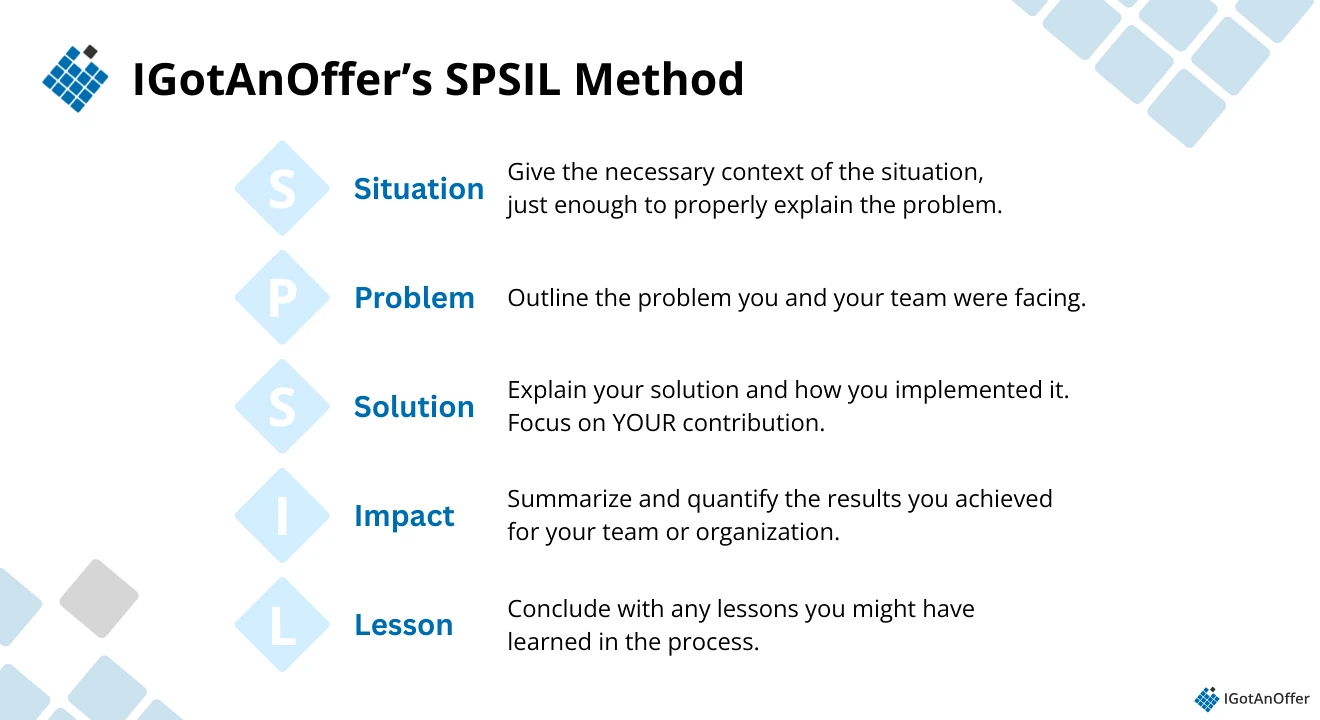
Let’s step through our suggested five-step approach:
- Situation: Start by giving the necessary context of the situation you were in. Describe your role, the team, the organization, the market, etc. You should only give the minimum context needed to understand the problem and the solution in your story. Nothing more.
- Problem: Outline the problem you and your team were facing.
- Solution: Explain the solution you came up with to solve the problem. Step through how you went about implementing your solution, and focus on your contribution over what the team / larger organization did.
- Impact: Summarize the positive results you achieved for your team, department, and organization. As much as possible, quantify the impact.
- Lessons: Conclude with any lessons you might have learned in the process.
You’ll notice that this method covers very similar themes to the STAR method. We like it because a lot of the candidates we work with find this framework easier to use, as there’s no overlap between any of the steps in your story.
For a deeper dive into this topic, check out our article on why the STAR method isn’t always the best for behavioral interviews and how IGotAnOffer's SPSIL method can be a better option. It was written with product managers in mind, but it applies just as well to any role.
Ultimately, you should practice using whatever method you’re the most comfortable with. If you’d like to start practicing right away, jump back to the full list of questions here.
Otherwise, to get a better idea of how our method works, work through the examples below.
3.2 Amazon behavioral interview: example answers
Now that you know how to approach answering behavioral questions, let's look at a few full examples.
To start off, we’ll use one of Amazon’s most frequently asked questions. You’ll see that it can be tailored to match a few different leadership principles, such as Ownership, Learn and Be Curious, and Deliver Results.
Try answering the question below following your preferred method. Play both the role of the interviewer and the candidate. Write down your answer, then practice saying it out loud before going through our example response. Once you’ve finished, compare your response to our example to fill in any gaps in your story.
Example answer to question: Tell me about a time you failed at work. What did you learn from it?
We’ll use the SPSIL method described above and answer as if interviewing for a product manager job at Amazon. You will find our proposed answer to the question below.
Note that this question isn’t necessarily about a specific role and allows you to describe a variety of situations. We’ll use a generic example, but you should, of course, use an example from your own work experience.
1. Situation
You could start by saying something like,
“In my last position, I was the product manager for a key feature of a new product we were about to launch. My team had been able to roll through research and development ahead of schedule, so I was excited to beat our deadline. In an update with our chief product officer, I told her that we were working quickly and would likely finish a week before the deadline. She was pleased to hear this and rearranged launch dates accordingly.”
Without giving too much detail, this gives a quick sense of the setting you were in. Now we’ll get into the problem.
2. Problem
Once you outline the situation, you can explain the problem by saying something like,
“However, I had allowed myself to get swept up in our previous progress and moved up our deadline without fully considering all the factors at play. As we continued work on the launch, it quickly became clear that the final details would take longer than anticipated, and we would not be meeting the earlier deadline.”
Here, you don’t spend too much time describing the situation and problem, but your answer so far has given the interviewer a clear sense of the setting and issue that arose.
3. Solution
When describing the solution you came up with to solve the problem, it’s important to step through your thinking. And it’s especially important to focus on YOUR contribution.
Of course, this will look a little different for a question asking about a failure, as it would mean you may not have solved the initial problem. However, you can underline the steps you took to address the failure once you realized it.
You could say something such as,
“As it was my mistake to move up the deadline, and not my team’s, I took it upon myself to speed up the process. First, we discussed our progress, and I added some of their workload to my plate to accomplish everything faster. I worked overtime to take care of the loose ends, then booked a new meeting with the chief product officer.
I explained to her that I had spoken too hastily and that we would not meet the new deadline that I had imposed. We reworked the launch plan and returned to the original timeline.
Ultimately, we were able to complete our preparations a couple of days before the original launch date, though not a full week ahead like I'd anticipated.”
Let’s take a step back and look at what you’ve shown with this answer. While you are putting on display a big mistake, your work to resolve it shows personal accountability. Instead of blaming the mistake on others, you accept blame and act to fix it. This is a key aspect of Amazon’s Ownership leadership principle.
Also, you went out of your way to speed up the process, working overtime to arrive closer to the due date. This shows that you can Deliver Results, another leadership principle.
4. Impact
After explaining the actions you took, it’s a good idea to quantify both the impact of the failure itself and how you mitigated it.
You could say something like,
“Clearly, the deadline mix-up had some negative repercussions, as the launch date was pushed forward and then moved back again. Thankfully, since it was only the earlier deadline I failed to
meet, the product was still able to be launched on the original launch date one week later.”
5. Lessons
Finally, wrap up your answer by describing any lessons you might have learned. This is the most important step for a question about a past mistake or failure, as Amazon wants to be sure you know how to avoid that mistake again. Also, constantly learning aligns with the principle Learn and Be Curious.
You could say,
“The failure to meet that deadline reminded me to make decisions based on data and observation, not excitement. Also, the final details of a project are extremely important and shouldn’t be rushed. These were both things I had been aware of before, but I had forgotten them in the excitement over how quickly we were progressing in other areas. Thankfully, since this mistake, I’ve always been meticulous about deadlines, only setting or changing them after I’ve discussed them with the team and considered the repercussions. Thanks to that, I haven’t missed a deadline since. ”
Example answer: How have you previously measured customer satisfaction?
Example answer by Jason (ex-Amazon PM)
1. Situation
"In my role as a product manager in the Amazon Marketplace organization, I encountered a significant challenge regarding declining retention rates among customers purchasing from individual sellers.
2. Problem
Despite consistent conversion rates, there was a noticeable decline in repeat purchases, indicating dissatisfaction among customers with their overall experience.
3. Solution
To address this, I conducted extensive research by engaging with both customers and individual sellers to understand their pain points. Through one-on-one conversations and surveys, I delved into their satisfaction levels, browsing experiences, and purchase behaviors. Additionally, I analyzed metrics such as conversion rates and repeat purchases to gauge overall customer satisfaction.
4. Impact
By triangulating qualitative feedback with quantitative data, I was able to pinpoint areas for improvement and devise targeted solutions to enhance customer satisfaction. Implementing improvements such as enhancing product detail pages, adding more images, and improving product descriptions resulted in a notable increase in repeat purchases and overall customer satisfaction.
5. Lessons
This experience taught me the importance of combining qualitative and quantitative methods to gain a comprehensive understanding of customer satisfaction. It underscored the significance of proactive engagement with customers and continuous iteration to meet evolving needs and preferences."
Example answer to question: Tell me about a time you struggled to meet a deadline
Example answer by Jason (ex-Amazon PM)
1. Situation
"As a lead product manager for a travel company, I faced a daunting challenge of increasing mobile ad revenue, which was significantly below industry standards.
2. Problem
Tight deadlines and resistance from other product teams advocating for the removal of ads posed significant obstacles to achieving our revenue targets.
3. Solution
To tackle this challenge, I initiated a comprehensive strategy that involved leveraging existing technology infrastructure, conducting rigorous A/B testing, and prioritizing mobile web and app platforms.
4. Impact
Despite initial skepticism and tight deadlines, I led my team through the execution of nine A/B tests, with seven yielding positive results. Through meticulous analysis and iterative improvements, we not only met but exceeded our revenue targets, ultimately demonstrating the effectiveness of our approach and reinforcing the importance of perseverance in the face of adversity.
5. Lessons
This experience underscored the importance of resilience, strategic planning, and collaboration in overcoming challenges and meeting deadlines in a dynamic and fast-paced environment."
Example answer: Tell me about a time you had to improve a difficult process
Example answer by Dessy (ex-Senior PM at Amazon)
1. Solution
"While working in e-commerce, we aimed to enable sellers to accept cash on delivery, leading to complex money flow processes.
2. Problem
Inaccuracies in invoicing, due to multiple money flows for each transaction, resulted in a 5% error rate.
3. Solution
After analyzing transaction processes, I simplified money flows, reducing them from four to two, and implemented flexible payment methods for sellers.
4. Impact
Accuracy in invoicing improved to over 99.5%, saving $400,000 and reducing finance operation time from five hours to less than one hour monthly.
5. Lessons
Reviewing processes comprehensively and implementing strategic changes can significantly enhance efficiency and accuracy."
Example answer to question: Tell me about a time you disagreed with your manager
Example answer by Dessy (ex-Senior PM at Amazon)
1. Situation
"While managing a tool for seller inventory management, my manager aimed to sunset an old widget quickly, but I disagreed due to potential customer impact.
2. Problem
The manager's timeline for sunsetting the old widget was too short, risking a negative customer experience.
3. Solution
I suggested a manual approach using a Google form for transitioning, allowing more time for customer migration without significant development.
4. Impact
By extending the migration period, 100% of impactful customers switched without negative customer experiences.
5. Lessons
Prioritizing customer experience and proposing practical interim solutions can prevent rushed decisions and ensure successful transitions."
3.3 Amazon behavioral interview - mock interview video
Answering behavioral questions can seem fairly straightforward on paper, but when you get into the actual interview, it can feel a bit more difficult.
We recommend watching and doing plenty of mock interviews. Check out the video below - Jason (ex-Amazon Product Manager) answers some very common leadership principle questions.
4. Amazon behavioral interview tips↑
Finally, before we move on to some interview prep resources, we'd like to give you five helpful tips to keep in mind.
4.1 Get used to setting up the situation in 30 seconds or less
Use a timer while you practice to ensure you provide only necessary information. Spending too much time on the Situation step is one of the most common mistakes candidates make.
4.2 Stay focused on essential details
Interviewers hear a lot of behavioral stories a day. If you go into unnecessary details, you are likely to lose their attention. Share your stories with a few different people before your interview and ask them what details they would suggest cutting.
4.3 Be proud and talk about YOU
This is not the time to be shy about your accomplishments. Concentrate on your impact, not what “the team” did. Not talking about YOU enough is another common mistake we see with a lot of candidates.
4.4 Adapt to follow-up questions
Don’t be alarmed if your interviewer asks follow-up questions; this is perfectly normal. Listen carefully to the way your interviewer is asking these questions, as there will often be a subtle clue about the specific skills they’re looking to assess from the next part of your answer.
4.5 Explain how failure made you better
When talking about failure, don’t try to hide your mistakes or frame a weakness as a strength. Instead, show what you learned and how you grew from the failure.
5. How to prepare for an Amazon behavioral interview↑
Right, now that we’ve been through all the questions and the techniques you can use to answer them, we’d like to offer some resources to help you prepare. Here are three steps that you can take to help you prepare for your Amazon or Amazon Web Services behavioral interview.
5.1 Learn about Amazon's culture
Most candidates fail to do this. But before investing tens of hours preparing for an interview at Amazon, you should take some time to make sure it's actually the right company for you.
Amazon is prestigious, and it's tempting to assume that you should apply without considering things more carefully. But it's important to remember that the prestige of a job alone won't make you happy in your day-to-day work. It's the type of work and the people you work with that will.
If you know people who work at Amazon or used to work there, talk to them to understand what the culture is like. The leadership principles we discussed above can give you a sense of what to expect, but there's no replacement for a conversation with an insider. Finally, we would also recommend reading the following resources:
- Amazon's technology culture video mix (by Amazon)
- Amazon vision and mission analysis (by Panmore Institute)
- Amazon strategy teardown (by CB Insights)
We also recommend reading our Amazon salary negotiation guide for more information about Amazon's compensation structure and how to maximize your offer once you ace your interviews.
It would also help you prepare better if you familiarize yourself with the entire interview process for your target role. Check out our guides to get started:
- Amazon product manager
- Amazon program manager
- Amazon technical program manager
- Amazon software development engineer
- Amazon software development manager
- Amazon data scientist
- Amazon applied scientist
- Amazon (technical) account manager
- Amazon machine learning engineer
- Amazon data engineer
- Amazon finance manager
- Amazon business intelligence engineer
5.2 Practice by yourself
Acing a behavioral question is much harder than it looks. You’ll stand out if you put in the required work to craft concise and direct answers.
First, take a look at this video by Amazon aimed at helping software development engineers prepare for behavioral interviews.
5.2.1 Write down your stories
Now that you've seen an example of a behavioral question at Amazon, work out which of your stories you’d like to tell. As mentioned in the video, make a list of key moments in your career (e.g., accomplishments, failures, team situations, leadership situations, etc.) that you can use to answer one or multiple questions.
We recommend you come prepared with at least one story per leadership principle, as well as a few ‘flex’ stories that you could apply to multiple. Watch this video to learn how to create your own story bank.
After you’ve finished your list, write out a story for each key moment in your career using the structure we've laid out in section 3. Be sure to emphasize your impact in each of these examples, quantify the results of your actions, and explain the lessons you learned from the experience.
Once you have a bank of stories, go through the questions in section 2 and make sure you’d be able to answer all of them either by using one of the stories you’ve written directly or by adapting it on the fly. If you identify any gaps, add stories to your bank until you’re comfortable that you can cover all the questions listed in this article.
Click here to download a PDF to help you prepare stories on each Amazon leadership principle.
Click here to practice with more common behavioral questions and see example answers
5.2.2 Practice your stories out loud
After you've written everything down, a great way to practice your answers is to interview yourself out loud. This may sound strange, but it will significantly improve the way you communicate during an interview.
You should be able to tell each story naturally, neither missing key details nor memorizing them word-for-word.
Play the role of both the candidate and the interviewer, asking questions and answering them, just like two people would in an interview. Trust us, it works.
Prepping for behavioral interviews at multiple tech companies? You may wanna check our other behavioral interview guides for FAANG+ and other top tech companies and for specific roles:
- Apple behavioral interview
- Meta behavioral interview
- Google behavioral interview
- OpenAI behavioral interview
- Capital One behavioral interview
- 40+ Most Common Behavioral Interview Questions
- 8 Most-Asked Product Manager Behavioral Interview Questions
- 11 Most-Asked Software Engineer Behavioral Interview Questions
5.3 Practice with peers
Practicing by yourself will only take you so far. By yourself, you can’t simulate thinking on your feet or the pressure of performing in front of a stranger. Plus, there are no unexpected follow-up questions and no feedback.
That’s why many candidates try to practice with friends or peers. If you have friends or peers who can do mock interviews with you, that's an option worth trying. It’s free, but be warned, you may come up against the following problems:
- It’s hard to know if the feedback you get is accurate
- They’re unlikely to have insider knowledge of interviews at your target company
- On peer platforms, people often waste your time by not showing up
For those reasons, many candidates skip peer mock interviews and go straight to mock interviews with an expert.
5.4 Practice with experienced Amazon interviewers
In our experience, practicing real interviews with experts who can give you company-specific feedback makes a huge difference.
Find an Amazon behavioral interview coach so you can:
- Test yourself under real interview conditions
- Get accurate feedback from a real expert
- Build your confidence
- Get company-specific insights
- Learn how to tell the right stories, better.
- Save time by focusing your preparation
Landing a job at a big tech company often results in a $50,000 per year or more increase in total compensation. In our experience, three or four coaching sessions worth ~$500 significantly impact your ability to land the job. That’s an ROI of 100x!











 Engineering manager, Technical program manager, Manager of TPMs +3 others